
Key Highlights
- Digital investment is rising, but automotive brand loyalty is quietly declining.
- The biggest loyalty drop happens after purchase, not before it.
- Disconnected systems create fragmented ownership experiences customers feel immediately.
- Mobile apps and digital touchpoints often fail to meet real ownership expectations.
- Traditional transformation metrics miss the real impact on customer lifetime value.
- Loyalty erosion is a business model risk, not just a technology issue.
Automotive brands are investing more in digital than ever before. New platforms, connected car experiences, mobile apps, and AI-driven personalization are everywhere. On paper, it all looks modern and advanced. Yet something uncomfortable is happening beneath the surface.
Customers are drifting away.
Repeat purchases are getting harder. Service relationships are weakening. Brand switching feels easier than it used to. And for many leaders, this creates a frustrating question: How can loyalty be falling when digital investment is at an all-time high?
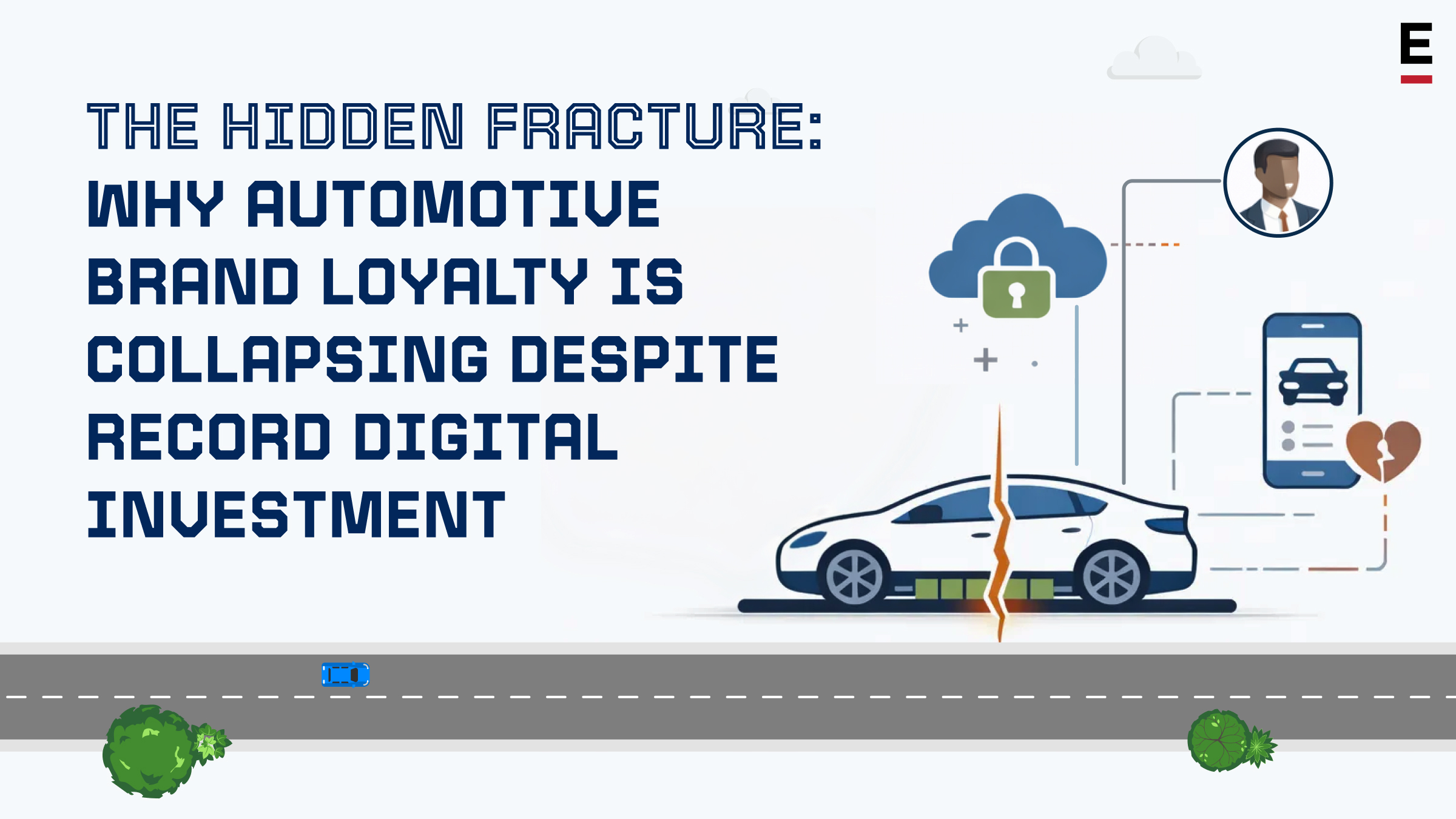
The answer lies in a gap most organizations don’t see clearly. Technology has moved forward, but the ownership experience hasn’t moved with it.
Why Automotive Loyalty Slips Despite Digital Investment
Most digital programs in the automotive industry are launched with the right intentions – improving operational efficiency, digitizing dealerships, and introducing new tools across sales and service. However, the focus often remains on system deployment rather than on the end-to-end driver experience over time.
As a result, OEMs and dealer networks operate with touchpoints that function in isolation instead of as part of a connected ownership journey. CRM, showroom, service, and connected vehicle systems sit in silos. Teams work in parallel. And drivers feel the disconnect.
From a customer’s point of view, loyalty isn’t shaped by platforms or backend dashboards. It’s shaped by continuity. Does the brand remember their last test drive? Is service history visible across dealerships? Do digital and in-store interactions feel connected? Does vehicle ownership become simpler over time or more fragmented?
When those answers are unclear, customer lifetime value begins to erode, quietly at first, then steadily.
From Vehicle Delivery to Disengagement
The biggest loyalty risk doesn’t happen before the sale. It happens after.
Many automotive brands see a noticeable drop in engagement between 72 hours and 18 months after purchase. This is when the excitement fades and day-to-day ownership begins.
Onboarding messages feel generic. Apps don’t reflect real service history. Dealership interactions don’t carry context from digital channels. Customers are asked to repeat the same information again and again.
None of these issues are dramatic on their own. But together, they send a subtle message: the brand isn’t really paying attention.
And when customers feel unseen during ownership, trust starts to erode. Once that happens, loyalty rarely survives the next buying decision.
Three Structural Failures Eroding OEM Brand Loyalty
Loyalty loss in automotive isn’t usually caused by one big mistake. It’s driven by structural issues that build up over time.
- The first is fragmented architecture. Customer and vehicle data live across multiple systems CRM, dealer platforms, service tools, apps without real-time alignment. This leads to partial views and inconsistent interactions.
- The second is the mobile expectation gap. Customers compare automotive apps to the best digital experiences they use every day. When apps feel slow, limited, or disconnected from real-world interactions, they fall short of expectations.
- The third is data blind spots. Without connected insights across sales, service, and ownership behavior, brands miss early warning signs. Dissatisfaction goes unnoticed. Churn risk isn’t visible. Loyalty-building moments pass by.
Together, these failures weaken relationships long before customers consciously decide to leave.
The Retention Blind Spot in Automotive Boardrooms
One reason this problem persists is how success is measured.
Digital transformation is often tracked through system rollouts, feature adoption, or usage metrics. These numbers look positive, but they don’t reveal what’s happening to loyalty.
The more important question rarely gets asked: Is our technology increasing customer lifetime value?
When retention drops, acquisition costs rise. Service revenue declines. Upsell and upgrade opportunities shrink. These are business outcomes, not technical ones but they’re often reviewed in isolation.
Without linking digital investment to retention economics, loyalty erosion stays hidden until it becomes expensive.
The Automotive Leadership Mandate
This isn’t a problem that can be fixed by adding another tool or launching another digital initiative.
Loyalty erosion is not an IT issue. It’s a business model vulnerability.
Solving it requires a shift in thinking from isolated touchpoints to connected ownership journeys. From channel-led execution to shared customer context. From measuring activity to measuring long-term value.
Automotive brands that succeed will be the ones that close the invisible gaps in the ownership experience. They’ll make interactions feel continuous, not fragmented. Intentional, not accidental.
Because loyalty doesn’t disappear overnight.
It fades one broken connection at a time.
Conclusion
Loyalty doesn’t break because brands lack technology. It breaks when systems, teams, and data fail to work together across the ownership journey. This is where automotive expertise matters.
At Extentia, a Merkle Company, we help automotive brands move beyond fragmented initiatives to build connected, insight-led experiences across sales, service, and ownership. By aligning systems around the customer, not channels, we help brands turn digital investment into lasting loyalty.
If you’re ready to close the invisible gaps in your ownership journey, it’s time to start with clarity and design what truly drives long-term value. Contact us!
Stay tuned for our next blog, where we’ll explore how leading OEMs are engineering loyalty at scale through experience-centric architecture frameworks.