
Key Highlights:
- Loyalty is built through continuous digital engagement, not just repeat dealership visits.
- System modernization without integration fails to improve retention.
- Leading OEMs focus on experience-centric architecture, not isolated loyalty programs.
- Three core pillars drive success: mobile orchestration, cloud intelligence, and scalable design systems.
- Predictive personalization requires unified, real-time data integration.
- Sustainable loyalty depends on aligning technology, design, and domain expertise at enterprise scale.
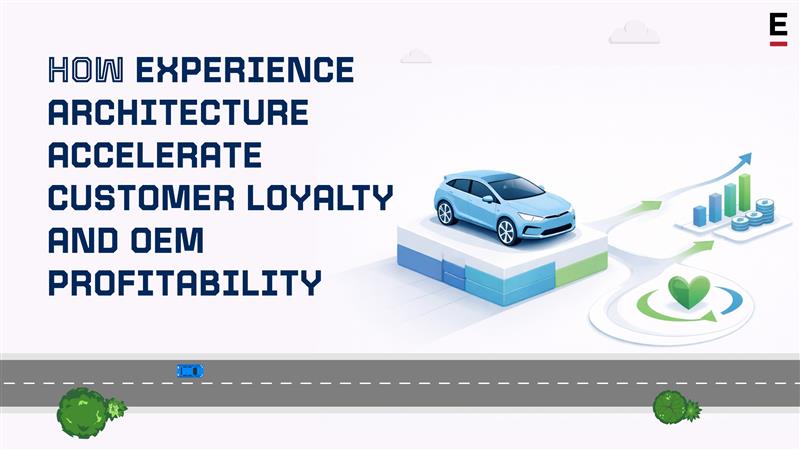
Why isn’t loyalty improving even as OEMs digitize every touchpoint? Because modern tools alone can’t fix fractured experiences. With data still siloed between dealers, service centers, digital apps, and connected vehicles, many OEMs lack a unified view of the customer, leading to inconsistent engagement and missed opportunities to deepen relationships between purchases.
What leading OEMs are doing differently is not launching more programs. They are rethinking the architecture that supports the entire customer experience.
Disconnected digital initiatives fail because they optimize features rather than relationships. A loyalty program that cannot access real-time vehicle data will always feel generic. A mobile app that does not integrate with service history cannot be proactive. A campaign engine operating on fragmented data will never feel timely. These are not marketing gaps. They are architectural gaps.
The OEMs moving the needle on retention are aligning around three integrated pillars: mobile orchestration, cloud intelligence, and design systems. Individually, each pillar adds value. Together, they create a framework where loyalty becomes a natural outcome of the experience.
Pillar 1: Mobile as the Continuous Relationship Layer
Mobile has become the primary way automotive brands stay connected with customers. It delivers service reminders, vehicle health insights, rewards tracking, financing updates, and contextual offers to maintain engagement between purchases without being intrusive.
But building a loyalty-driving mobile ecosystem means going beyond a clean UI. It depends on:
- Effortless identity management that is both secure and seamless for users
- Real-time API integrations that connect backend systems instantly
- Scalable performance that works reliably across regions
- Architectural flexibility that supports continuous evolution, not one-off releases
- Orchestration across systems so mobile becomes the bridge between customer intent and enterprise intelligence
When mobile successfully orchestrates these interactions, customer behavior changes: engagement becomes habitual rather than occasional, and loyalty grows through consistent value.
Pillar 2: Cloud Infrastructure for Predictive Personalization
If mobile is the interface, cloud infrastructure is what gives it intelligence. Automotive customer journeys span connected vehicles, dealership networks, service centers, digital platforms, and customer support systems. But in most OEM environments today, data remains siloed across systems, creating disconnected customer views and preventing real‑time orchestration of experiences.
Legacy IT landscapes make it difficult to unify data, and without continuous access to consistent insights, personalization stays reactive rather than anticipatory, insight‑to‑action cycles are slow, and engagement opportunities are often missed.
With the right cloud foundation, OEMs can:
- Unify customer and vehicle data into a single 360° view for consistent, cross-channel engagement.
- Deliver real-time personalization, anticipating service needs, tailoring offers, and recommending upgrades at exactly the right moment.
- Enable instant, event-driven analytics instead of slow batch processing.
- Accelerate insight-to-action cycles so teams can proactively engage customers rather than react.
- Strengthen decision-making and operational agility with faster access to unified data and insights.
Pillar 3: Design Thinking as Competitive Advantage
Technology creates capability, but design determines perception. In automotive digital ecosystems, exceptional design is no longer optional. Customers expect intuitive navigation, frictionless service booking, and clear visibility into rewards and benefits. If an experience feels complicated, trust erodes quickly. Design systems bring structure and scalability. Design standards ensure consistency across mobile apps, portals, and emerging touchpoints. They accelerate development while maintaining brand coherence.
More importantly, customer-centered interfaces embed customer empathy into digital transformation efforts. Customers do not see backend integrations or data orchestration. They experience simplicity. The brands that simplify complexity consistently outperform competitors in customer retention.
The Integration Challenge: Where Transformations Stall
Many transformation initiatives struggle during integration. Mobile teams move quickly. Backend teams focus on system stability. Data teams prioritize reporting. Experience teams focus on journey mapping. Without unified governance, these efforts drift apart.
Traditional system integrators often excel at backend implementation but may lack the experience-centric mindset required for holistic transformation. Automotive digital transformation demands alignment across mobile engineering, cloud infrastructure, data orchestration, and design systems. It also demands a deep understanding of dealership ecosystems, connected vehicle platforms, and loyalty economics. Without that combination, initiatives remain incremental rather than transformative.
Choosing the Right Transformation Partner
OEMs evaluating transformation partners should prioritize two critical factors.
First: deep automotive domain expertise. Understanding dealership operations, lifecycle engagement, service economics, and connected vehicle ecosystems is essential for designing meaningful loyalty strategies. Extentia, a Merkle Company brings this deep automotive focus, helping leading OEMs unify data, personalize engagement, and deliver seamless, connected experiences across digital platforms, service, and ownership journeys.
Second: proven enterprise‑scale mobile and cloud integration capabilities. API‑driven architecture, scalable cloud frameworks, secure mobile ecosystems, and experience orchestration must be core strengths rather than secondary offerings. Extentia’s enterprise mobility and cloud engineering capabilities, backed by a design‑centric transformation approach, ensure solid integration, scalable performance, and modern digital platforms that support real‑time engagement and loyalty outcomes.
For more context on the loyalty challenge and why today’s automotive digital investments are not delivering lasting customer retention, read The Hidden Fracture: Why Automotive Brand Loyalty Is – Extentia, the first post in this series that explains where traditional loyalty efforts are breaking down and what’s at stake for OEMs.
If your organization is ready to move beyond fragmented initiatives and build an architecture designed to sustain loyalty at scale, connect with us. Let us help you engineer loyalty that endures.