
Key Highlights:
- New Pune address, same SAP AppHaus mindset
- Bigger XEN LAB built for hands-on Design Doing
- 20 external business leaders experienced XEN first-hand
- 5 teams explored 5 future-focused scenarios
- 5 prototypes brought to life in just one hour
- AI, XENTools and human-centric design came together
In 2019, XEN LAB – Extentia, a Merkle company’s design doing space, became the first SAP AppHaus Network member in India. A lot has changed since then.
The technologies we work with have moved quickly, AI has entered almost every business conversation, customer expectations have shifted, and the problems businesses bring to the table rarely sit neatly within one function anymore. They cut across experience, technology, data, operations and strategy, often all at once.
XEN LAB has evolved alongside those changes, and now, it has a new address in Pune.
The space is new, but the thinking behind it is familiar. Bring the right people into the room. Spend enough time understanding the problem before racing towards a solution. Use structured methods to look at it from different angles. Make ideas tangible early enough to question them, improve them or throw them away, and try something better.
That has always been central to the AppHaus way of working, and it continues to shape what happens inside the new XEN LAB.
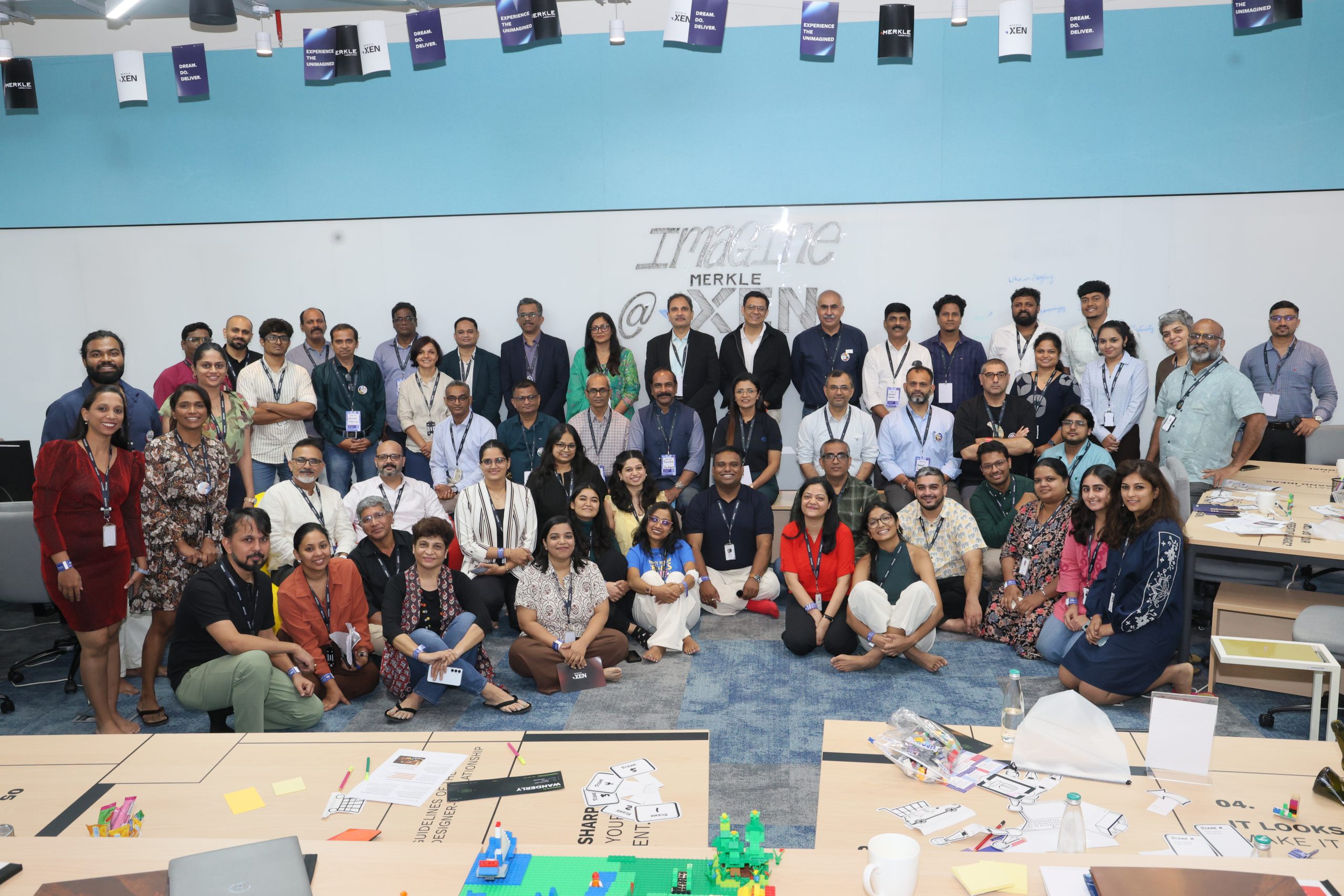
We recently got a chance to put the space, and that thinking to work when 20 external business leaders joined us for Experience the Unimagined, an evening built around AI, research, ideation, experimentation and future-led Design Doing.
A Bigger Space Built for Design Doing
Walking into the new XEN LAB, there is plenty to explore, but the idea was never to create a space where people simply walk around looking at displays. It is meant to be used.
During Experience the Unimagined, guests moved through different parts of the LAB and explored XENTools, Ideathon and XPLORE, along with Grey Patterns, Experience Design Trends, AI in XD, Market Research and our eight curated XEN workshop offerings.
- XENTools, Ideathon and XPLORE: Core XEN enablers and gamified experiences. Practical tools, creative challenges, and guided methods that show what makes XEN Workshops different.
- Grey Patterns: A hands-on look at dark, light, and grey patterns. Helps teams spot what works, what hurts, and where experience design needs a fix.
- Experience Design Trends: Research-driven trend signals for Auto, Health, and Financial Services. Future-facing insights, distilled through the DRIVER framework into clear action.
- AI in XD: This showcases how we enable AI workshops for our clients, helping define their AI strategy, get AI ready, and identify impactful AI use-cases. This zone will also showcase how we are leveraging AI to accelerate our processes across the India Design Studio.
- Market Research: All XEN workshops are preceded by significant market and desk research that enables us to bring an outside-in PoV during the discovery stages. This includes competitor studies, current pain-point identification and stakeholder expectation mapping. This zone showcases our Market Research capabilities as an integral enabler for XEN.
- Workshop Offerings: Through XEN we have curated a set of different workshop offerings based on commonly occurring client needs. Our workshops bring stakeholders together to align on priorities, define experience direction, and accelerate decision-making. We are showcasing 8 different workshop offerings.
Each offered a different way into a business or experience problem, whether that meant spotting emerging patterns, understanding customers better, generating ideas, challenging assumptions or exploring how AI could become part of the process.
But the real test of a space like this is what happens when you give people an actual problem and ask them to work with it.
That is where Design for the Future came in.
A Glimpse into Five Possible Tomorrows
Most business workshops begin with a problem that exists today.For this one, we deliberately did something different. The 20 participating leaders were divided into five teams, with members of our Experience Strategy team joining each group. Every team received a fictional business, but there was another catch: that business had to operate in a future where one of today’s emerging shifts had become part of everyday life.
Imagine running a media company in a world where deepfakes have made people suspicious of almost everything they see online. Or building a digital platform when people no longer give away their attention for free and expect something in return for it.
What happens to personalization when customers become increasingly reluctant to share their data? How does freight work when sustainability is no longer a nice-to-have, but an expectation attached to every purchase? What happens to travel when AI agents increasingly make decisions on behalf of customers?
None of these scenarios came with a neat answer, and that was precisely the point.
Instead of asking teams to predict the future, we asked them to step into it for an hour, understand how people might behave differently, and work out what a business would need to do in response.
Five Ideas, Made Tangible
Once each team had entered its future world, the next challenge was to make sense of it.
Using curated XENTools and pre-made AI avatars, participants reconsidered their personas in the context of that future, identified changing behaviours and emerging needs, and started exploring possible responses. Members of the Experience Strategy team worked alongside them, helping turn broad observations into more specific experience opportunities. Then came the part that changed the conversation: they had to make the idea tangible.
Within the one-hour workshop, five teams moved from unfamiliar future scenarios to five concepts and prototypes.
Civic Media – Verified News & Trust Platform
In a world struggling to distinguish real content from synthetic content, Civic Media makes the verification behind every story visible, helping readers understand where information came from and whether the content they are consuming is authentic.
Pulse – Attention Rewards Platform
Pulse responds to a future where attention has value of its own. Users decide when and how they want to engage with content and advertising and are rewarded for the attention they choose to give.
Wellspring – Personalized Wellness Companion
Wellspring explores how personalization could work without asking people to surrender control of their information. The privacy-first wellness solution uses inputs such as steps, hydration, sleep, activity and wellness goals to provide relevant recommendations while keeping users in control of what they share.
Freight OS – Sustainable Freight Management
Freight OS brings environmental impact into the same decision as speed and cost, allowing customers to compare delivery choices and understand the sustainability implications of how their shipment moves.
Wanderly – AI-Powered Travel Digital Twin
Wanderly imagines travel in a world where AI understands not only where someone wants to go, but how they like to travel. Its digital twin learns from previous preferences, likes and dislikes to help shape increasingly personalized travel experiences.
An imagined future suddenly became something people could see, discuss and challenge.
The AppHaus Journey Continues
Experience the Unimagined gave us an early look at what combination of unimagined thinking, AI, and human-centric experience design can produce in a new space: 20 external business leaders, five teams, five future scenarios, five prototypes created within an hour.
That feels like an appropriate way to begin the next chapter. The space is new, and the tools are evolving, but XEN LAB remains a place where difficult questions get the room they deserve.
It is ready for more questions, more perspectives, and many more ideas yet to take shape.
This is only the beginning.