
Key Highlights:
- SAP AppHaus Partner Meetup 2026 reinforced the importance of human-centered innovation in an AI-driven world
- Strong focus on co-innovation and collaboration across the AppHaus partner ecosystem
- AppHaus methodology continues to evolve with AI, cloud, and platform technologies
- Real-world innovation showcased across manufacturing and retail environments
- Extentia demonstrated how AppHaus methodology scales within a larger organization
- Ethical design gained attention through discussions on Grey Patterns
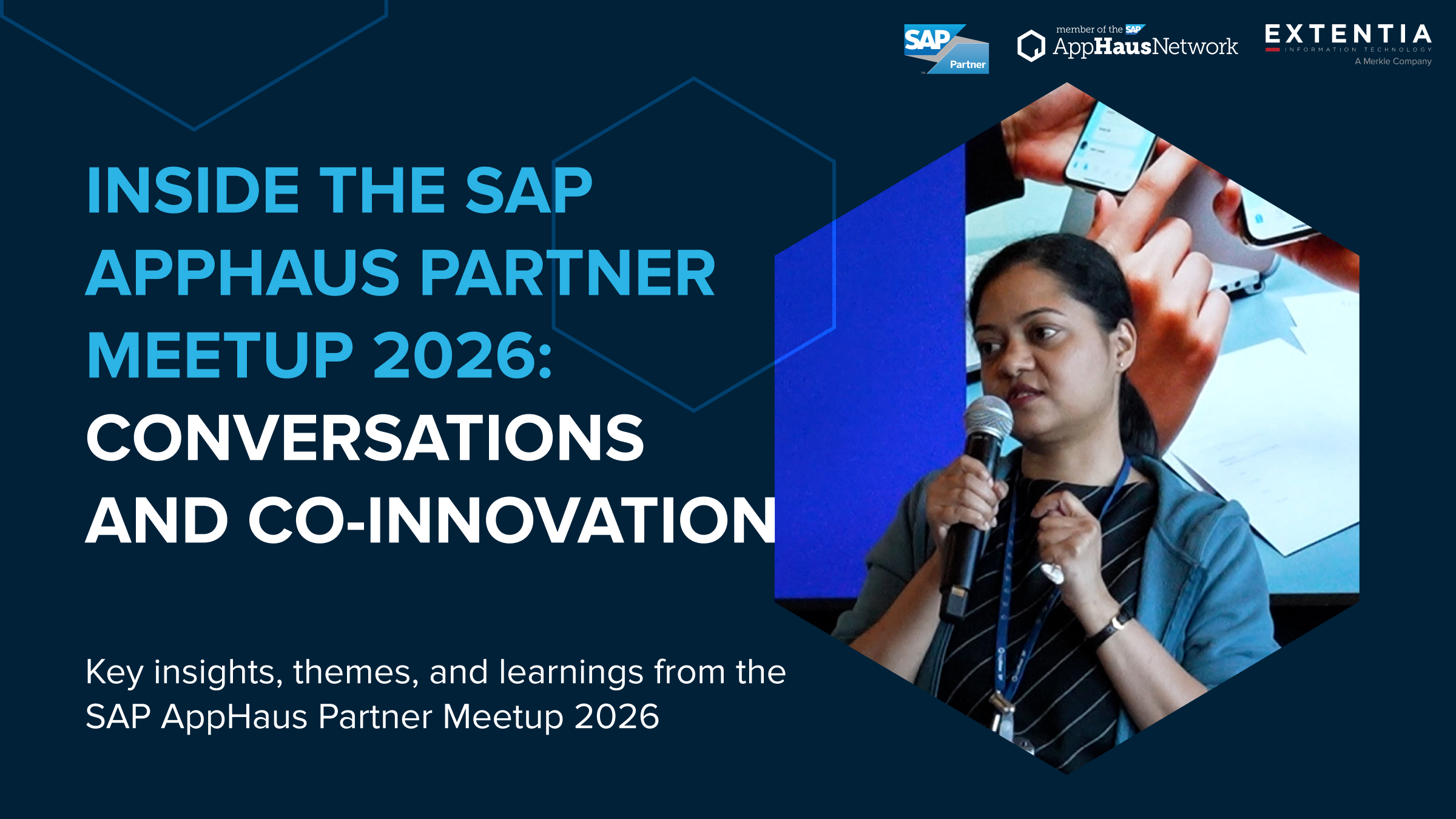
Every year, the SAP AppHaus partner community gathers to exchange ideas, share experiences, and reflect on how innovation is evolving across industries. The SAP AppHaus Partner Meetup 2026 was no different. Held in Walldorf, Germany, the three-day event brought together partners from across the SAP AppHaus Network to talk about what’s working, what’s changing, and where the future of human-centered innovation might be headed.
Hosted by SAP from February 24 to 26, the meetup created a space for open conversations. Some discussions were strategic, some were hands-on, and many simply involved partners sharing what they had learned from real client projects.
One theme kept resurfacing throughout the event: technology may evolve quickly, but meaningful innovation still starts with people.
The AppHaus ecosystem has always been rooted in that philosophy. Design thinking workshops, collaborative discovery sessions, and co-innovation programs are all designed to solve real business challenges while keeping user needs at the center. This year’s meetup explored how that approach continues to adapt as AI, automation, and cloud platforms become more deeply embedded in enterprise technology.
Day 1: Seeing Innovation in Practice
The first day began with a welcome session from the AppHaus leadership team. They reflected on how the network has grown over the years, from its early days supporting customers before solution development to becoming a global community of innovation partners.
The technology landscape has changed dramatically during that time. The ecosystem has evolved alongside SAP innovations such as SAP Fiori, Leonardo, cloud platforms, and the Business Technology Platform. Yet despite these shifts, one thing has remained steady: the focus on human-centered innovation.
A fireside conversation with senior SAP leaders set the tone for the rest of the day. Dennis Kecskemeti ((Head of Innovation Experience), Paul Saunders (Head of Customer Outcomes & Advocacy), and Andreas Wendel (Head of Experience Services) spoke about how creativity, storytelling, and industry expertise are becoming increasingly important in digital transformation projects.
Technology, they emphasized, should never be the hero of the story. Customer value should be.
Another highlight of the day was a keynote by Carlos Estala Velasco (Co-Lead SAP AppHaus Partner Network) that outlined the future direction of the AppHaus ecosystem. The idea is to bring together three complementary strengths: AppHaus methodology, SAP Experience Centers, and co-innovation services. When combined, these elements create a pathway that helps organizations move from early inspiration to real-world implementation. Beyond presentations and discussions, the day also included guided tours of several innovation environments at SAP.
At S.Factory, attendees saw how digital manufacturing connects cloud software with real production environments. Real-time dashboards, integrated planning systems, and automated production processes illustrated how manufacturing operations can become more connected and transparent.
The S.MART experience center focused on retail challenges such as fraud detection, inventory management, and real-time data visibility. Meanwhile, the Experience Labs showcased how SAP uses its own technologies internally to test real scenarios essentially acting as “customer zero” before deploying solutions to the wider market.
Day 2: The Power of Collaboration
If the first day focused on exploring innovation environments, the second day shifted attention toward collaboration across the partner ecosystem.
Several sessions explored how SAP Experience Centers are used to initiate transformation conversations with business leaders. These spaces are designed to help organizations visualize future possibilities, explore industry-specific scenarios, and begin shaping digital strategies in a structured way.
Another workshop introduced SAP’s experience service portfolio, which supports organizations throughout the innovation lifecycle. Engagements can start with strategic conversations at the executive level, move into design workshops, and eventually lead to large-scale proof-of-concept initiatives.
In other words, the goal was not just to generate ideas, but to turn those ideas into tangible outcomes.
One of the partner sessions that resonated strongly with attendees was presented by Melinda Rodrigues, Senior Strategy Analyst from Extentia, a Merkle Company.
Her talk focused on something many organizations struggle with: how to preserve the spirit of innovation while operating inside a larger corporate structure. She shared how Extentia successfully integrated the AppHaus methodology into the broader Merkle organization.
What started as a workshop-driven approach has gradually evolved into a structured framework used across presales engagements, discovery sessions, and innovation initiatives. Teams now use the methodology to clarify requirements, encourage collaborative problem-solving, and strengthen storytelling during client pitches.
It was an encouraging reminder that innovation frameworks can scale within large organizations, provided the mindset behind them remains intact.
The day wrapped up with discussions around event strategies and marketing initiatives within the AppHaus ecosystem. Partners exchanged ideas on how to create more engaging experiences during industry events, from mini workshops and interactive demos to rapid proof-of-concept showcases.
Day 3: Methods, Tools, and Learning from Each Other
The final day of the meetup shifted the conversation toward methods and practical tools.
Participants explored updates to the AppHaus design toolkit, including new learning paths and AI-focused human-centered design methods. These improvements aim to make the methodology easier to adopt for teams that may be encountering it for the first time.
Partners also shared case studies from their own projects. These sessions highlighted something that many innovation initiatives overlook: the importance of involving business decision-makers alongside technical teams. When executives participate directly in workshops, discussions tend to focus less on technical possibilities and more on real business outcomes.
Another interesting session introduced the concept of Grey Patterns in experience design, presented by Melinda. The framework encourages teams to examine how subtle design choices influence user behavior.
By evaluating interactions through criteria such as visibility, control, benefit, and intent, teams can identify potential issues early and design more balanced experiences.
As digital platforms become increasingly intelligent and personalized, these conversations around ethical design are becoming more relevant than ever.
What Stood Out
Looking back at the three days of discussions, a few themes clearly stood out.
First, innovation still begins with people. Even in an AI-driven world, human creativity, empathy, and collaboration remain essential.
Second, the partner ecosystem plays a crucial role in translating technology capabilities into real customer value. Innovation rarely happens in isolation.
And finally, co-innovation frameworks are becoming increasingly important. Organizations want structured approaches that help them move from ideas to scalable solutions.
Continuing the Journey
For Extentia, a Merkle Company, the meetup offered valuable insights and new perspectives. The conversations reinforced the importance of combining design thinking with strong engineering and digital strategy capabilities.
As part of the SAP AppHaus Network, Extentia continues to collaborate with partners and clients to explore new possibilities through human-centered innovation.
If your organization is exploring how design-led discovery workshops and co-innovation frameworks can support digital transformation, connect with us to learn more about our SAP AppHaus methodologies, and how they can help turn ideas into practical, scalable solutions.